Does AI-Generated Content Affect SEO? What Google Says
Digital marketing is rapidly transforming, and at its core, content creation has become essential for attracting traffic and boosting search engine rankings. Over the past few years, artificial intelligence (AI) has revolutionized content creation, making generating text for websites, blogs, and social media easier and faster. AI-generated content, produced by large language models such as ChatGPT, Gemini and Claude, can now mimic human writing, allowing businesses to scale their content production. This post sets out what Google has actually said about it, updated for October 2026.
Key takeaways
- AI-generated content does not hurt SEO by itself; Google judges how helpful and reliable content is, not how it was made.
- Mass-produced, low-value pages can be treated as scaled content abuse under Google's spam policies, and Google's quality raters are told to rate low-effort generative AI pages Lowest.
- AI content ranks best when edited for accuracy, depth and first-hand experience (E-E-A-T), which a model cannot supply on its own.
- AI Overviews and AI Mode now answer many informational queries directly, so a page can rank and still lose clicks; original data and clear answers earn citations.
- Use AI for speed and structure; keep a named human review step before anything is published.
As SEO continues to evolve, marketers need to understand how AI-generated content can influence search engine rankings and whether it can be leveraged for better results. While AI offers numerous benefits—speed, cost efficiency, and scalability—its impact on SEO is still debated among industry experts.
What is AI-Generated Content?
AI-generated content refers to text created using artificial intelligence tools and algorithms, such as natural language processing (NLP) models, capable of producing human-like writing. These tools, powered by machine learning, analyze vast amounts of data to understand language patterns, grammar, context, and nuances. As a result, they can generate text that resembles what a human might write, whether it’s articles, blog posts, product descriptions, social media updates, or even poetry.
Today’s most common form of AI-generated content comes from large language models such as OpenAI’s GPT models, Google’s Gemini and Anthropic’s Claude, which can craft coherent and contextually relevant text based on a simple prompt. These AI systems are trained on vast datasets, including books, websites, and other textual resources, enabling them to produce written content on various topics.
How AI Content is Created:
- Input or Prompts: The AI begins by receiving input from the user, such as a keyword, phrase, or question.
- Data Processing: Using pre-trained models, the AI analyzes patterns in the input and generates relevant responses based on the context it has learned.
- Output Generation: The AI produces output in the form of readable and coherent text, which can be refined further through editing if necessary.
Applications of AI Content:
- Blog Posts & Articles: AI can produce high-quality blog posts and articles on various topics, saving content creators time and effort.
- Product Descriptions: E-commerce businesses use AI to generate bulk product descriptions that are consistent and SEO-friendly.
- Social Media Content: AI tools can automatically generate posts for social media platforms with relevant hashtags and engaging language.
- Emails & Newsletters: AI assists in crafting personalized email campaigns to engage customers and promote products.
Does AI Written Content Affect SEO?

The central question surrounding AI-generated content is its impact on SEO. In an age where search engines prioritize high-quality, relevant, and engaging content, can AI-written material boost or hinder SEO performance? The short answer is that AI-generated content can affect SEO, but the degree to which it does depends on how the content is created and utilized.
How AI-Generated Content Can Impact SEO:
- Keyword Optimization:
AI tools can analyze and optimize content for specific keywords, helping businesses improve their chances of ranking for those terms. These tools can suggest the most relevant keywords based on search volume and competition, ensuring the content is aligned with what users are searching for. However, the challenge is ensuring that AI doesn’t over-optimize content by stuffing keywords unnaturally, which can lead to penalties from search engines.
- Content Relevance and Quality:
AI content generation can create material that is both relevant and aligned with user search intent. For example, AI can be trained to create content that answers specific questions or solves particular problems, which is vital for SEO. However, content quality remains a concern. While AI can produce grammatically correct text, it might lack the depth, originality, and nuance that human-created content offers. Search engines like Google are increasingly prioritizing content that provides real value to users, and generic AI-generated text might fall short in this area.
- Engagement and User Interaction:
Well-crafted AI-generated content can satisfy readers, which shows up as people reading on, returning and recommending the page. Google has said that bounce rate and time on site are not direct ranking factors, so treat them as signs of whether the page is helpful rather than as levers. Generic AI content that readers abandon is a sign the page does not answer the query, and that is what Google's helpful-content signals pick up. - Freshness and Volume of Content:
AI’s ability to produce large volumes of content quickly can be beneficial for SEO, especially in industries that require frequent updates or new content. Regularly updated content can improve a website’s relevance and authority in the eyes of search engines, as fresh content is often prioritized in rankings. But without proper quality checks, an overload of AI-generated content can dilute the website’s value if the material doesn’t provide real value to readers.
- Google’s Algorithm:
Google’s ranking systems continue to evolve, and since March 2024 the helpful-content signals are part of the core ranking system rather than a separate system. Google doesn’t specifically penalize AI-generated content but prioritizes content that aligns with its guidelines, focusing on E-E-A-T (Experience, Expertise, Authoritativeness, and Trustworthiness). AI-generated content that fails to meet these criteria might perform poorly in rankings due to lacking depth or real human experience.
Advantages of AI Content for SEO
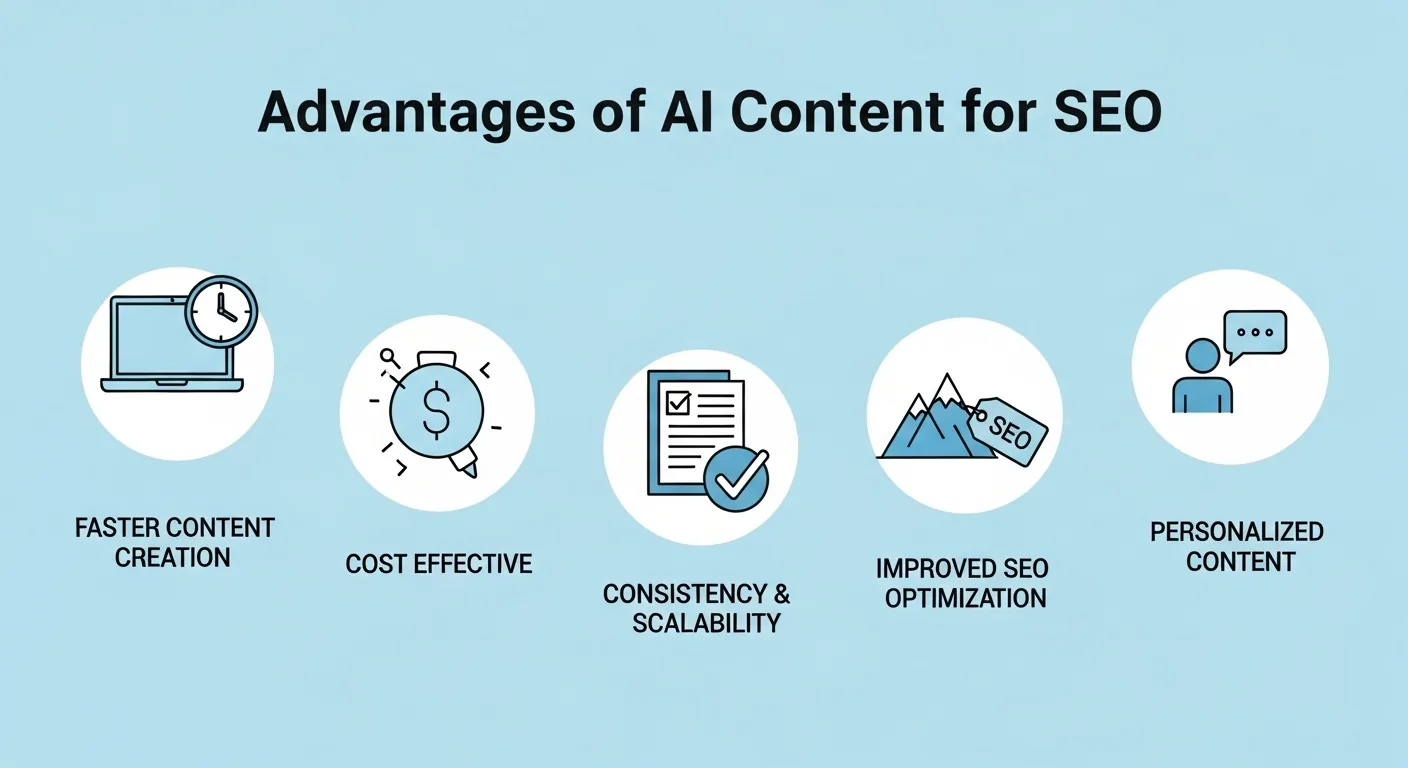
AI-generated content offers several benefits for SEO, making it an attractive option for businesses looking to improve their online visibility. Here are some of the key advantages:
Faster Content Creation
AI can significantly speed up the content creation process. Instead of spending hours or days writing content manually, AI tools can produce articles, blog posts, and product descriptions in a fraction of the time. This enables businesses to scale their content production and meet the demands of frequent updates or large-scale content strategies.
Cost-Effective
Hiring a team of writers for ongoing content production can be expensive. With AI, businesses can reduce the need for extensive human labor, making content creation more affordable. AI-generated content can serve as a cost-effective solution, especially for tasks like writing basic articles or descriptions.
Consistency and Scalability
AI can maintain consistency in tone, style, and formatting across large volumes of content. This ensures that all content on a website follows the same guidelines and is aligned with SEO best practices. Whether you need a hundred product descriptions or several blog posts per week, AI can scale the content production process without compromising quality.
Improved SEO Optimization
AI tools are often designed with SEO in mind. They can suggest relevant keywords, optimize content structure, and ensure proper keyword density. This helps ensure that the content is more likely to rank well in search engines. AI can also assist with on-page SEO elements like meta descriptions, header tags, and internal linking.
Personalized Content
AI can analyze user behavior and preferences to generate highly personalized content. Businesses can improve engagement and relevance by tailoring content to specific audience segments, positively influencing SEO rankings.
Google’s Stance on AI Content
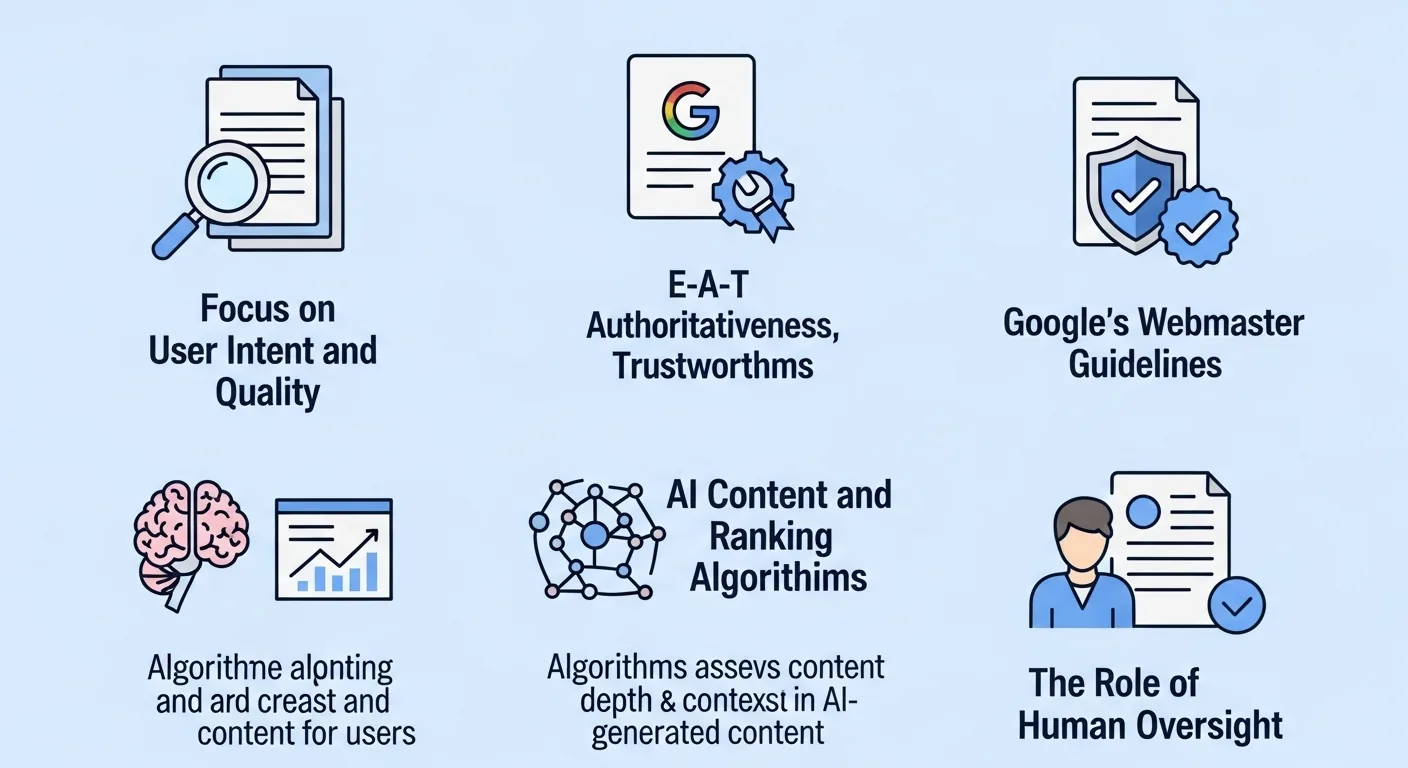
Google’s approach to AI-generated content has evolved, as it continues to refine its algorithms to focus on content quality, user experience, and relevance. While Google doesn’t explicitly ban AI-generated content, it has guidelines that content must adhere to to rank well. Here’s how Google views AI-generated content concerning SEO:
Focus on User Intent and Quality
Google’s primary goal is to deliver to users the most relevant, helpful, and high-quality content. AI-generated content can rank well if it meets these criteria. However, if the content is produced solely to manipulate rankings (e.g., through keyword stuffing or low-quality writing), it’s less likely to perform well in search results. Google’s ranking systems are built to reward content that serves user intent rather than content made only to rank.
E-E-A-T (Experience, Expertise, Authoritativeness, and Trustworthiness)
Google emphasizes the importance of E-E-A-T (Experience, Expertise, Authoritativeness, and Trustworthiness) in content. AI-generated content often lacks deep expertise or original insights and can struggle to meet these standards. Google values content that demonstrates authority on a topic, which is why human involvement in content creation is essential, especially in technical or niche subjects requiring specialized knowledge.
Google Search Essentials
According to Google Search Essentials (formerly the Webmaster Guidelines), content should be created primarily for users, not search engines. AI-generated content created solely for the purpose of ranking in search engines—without considering users’ needs—may fall into the category of “spammy” content. Google encourages content creators to focus on providing value to readers, with AI tools acting as a complement to, rather than a replacement for, thoughtful content creation.
AI Content and Ranking Algorithms
Google’s ranking systems, from RankBrain and BERT to MUM and the language models behind AI Overviews, are designed to understand content’s context and intent, not just the keywords. Since March 2024 the helpful-content signals sit inside the core ranking system, and the core updates of 2025 and 2026 have kept demoting sites built from large volumes of unoriginal pages. AI-generated content that lacks context, depth, or first-hand experience may therefore rank below pages where a person has added something real, whatever tool produced the first draft.
The Role of Human Oversight
To align with Google’s guidelines, humans should always review and edit AI-generated content. Ensuring that AI content maintains quality, relevance, and expertise is key to improving its SEO performance. While AI can assist with content generation, human editors are crucial for making the content more authentic, engaging, and aligned with user intent.
What Google Has Actually Said, With Dates
Because this post is about what Google says, here is the record as of October 2026:
- February 2023, "Google Search's guidance about AI-generated content". Google stated that using automation, including AI, to create content is not against its guidelines, and that it rewards high-quality content however it is produced. Using AI mainly to manipulate rankings is a violation of its spam policies.
- December 2022, E-E-A-T. Google added Experience to E-A-T. First-hand experience, such as photos of your own work, test results or a case from a client, is the part AI cannot supply.
- March 2024 core update and spam update. The helpful content system was folded into Google's core ranking systems, and new spam policies arrived: scaled content abuse (many pages produced mainly to manipulate rankings, by AI or people), site reputation abuse (third-party content published on a reputable site to exploit its rankings, enforced from May 2024 and widened in November 2024) and expired domain abuse.
- January 2025 Search Quality Rater Guidelines. The guidelines now tell raters to give the Lowest rating to pages created with generative AI, or other automated means, with little effort, originality, added value or real expertise. Raters do not set rankings directly, but the wording shows what Google's systems are trained to reward and demote.
- Core updates in 2025 and 2026. Google ran several core updates in 2025, including March and June, and has continued in 2026. Sites that publish large volumes of unoriginal pages have repeatedly lost visibility in these updates, while sites that add first-hand expertise have held or gained.
AI Overviews and AI Mode: The Bigger Change for AI Content
Google now answers many searches itself. AI Overviews appear at the top of results for a growing share of informational queries, and AI Mode offers a full chat-style search; both are available in Pakistan. This changes the question from "will my AI-written page rank?" to "will anyone click it even if it ranks?"
- Citations, not just rankings. AI Overviews and AI Mode cite a few sources per answer. Pages that bring something new, such as original numbers, local prices in PKR, a step-by-step test you ran or a clear definition, get cited; pages that paraphrase the same general advice do not.
- Impressions up, clicks down. Informational queries lose clicks when an AI answer resolves the question on the results page. Search Console does not separate AI Overview traffic, so watch the click-through rate of your informational queries rather than impressions alone.
- Commercial and local queries hold up better. Searches such as "SEO agency Lahore" or "price of a 1.5 ton inverter AC in Karachi" still send people to pages, because the user needs a provider or a product, not an explanation.
- What to do. Use AI for outlines and first drafts, then add what only you have: your own data, client examples, photos, and an author who can be checked. Answer the main question clearly near the top of the page so an AI answer can quote it, and keep the rest of the page worth the visit.
When AI Content Becomes Spam: Google's Scaled Content Abuse Policy
In March 2024, Google added a spam policy called scaled content abuse. It covers producing many pages mainly to manipulate rankings rather than to help users, whether the pages are made by AI, people or a mix. Its sibling policy, site reputation abuse, covers third-party content (such as bulk AI articles or coupon pages) hosted on an established site to borrow its rankings. Typical examples:
- Hundreds of near-identical city or service pages with only the place name changed.
- Articles generated from a keyword list and published without review.
- Scraped or lightly rewritten content from other sites, stitched together.
- Pages that target search terms but do not actually answer them.
- A news or education site renting a subfolder to an outside operator who fills it with AI pages.
A quick safety check before you publish AI-assisted content:
- Would this page be worth creating if search engines did not exist?
- Does it include something a reader cannot get from the top results already, such as your experience, examples or data?
- Has a named person checked every fact and claim?
- Are you publishing at a pace your team can genuinely review?
If you can answer yes to all four, using AI is not the problem.
Conclusion
AI-generated content can enhance SEO by enabling faster creation, scalability, and effective keyword optimization. However, it must be combined with human oversight to maximize its benefits to ensure quality, originality, and relevance, avoiding issues like keyword stuffing or duplicate content. By focusing on user intent, aligning with Google’s E-E-A-T guidelines, and regularly updating content, businesses can leverage AI to improve SEO rankings while maintaining the authenticity and value needed for long-term success. Balancing AI’s efficiency with human creativity is key to a sustainable and effective SEO strategy.
Frequently asked questions
Can Google detect AI-generated content?
Google has not said it runs an AI detector to demote content, and its stated focus is on quality rather than origin. It does not need to detect AI to act: pages that are thin, repetitive, inaccurate or published at scale to game rankings are caught by its ranking systems and spam policies anyway. Aim to make content useful, not undetectable.
Will AI content get my website penalised?
Not simply for using AI. Problems come when a site publishes large numbers of low-value pages, copies or spins other sites, or fills pages with keywords. These can lead to lower rankings or a manual action under Google's spam policies. A site that uses AI for drafts and then edits, fact-checks and adds real expertise is not at risk because of the tool.
Should I tell readers that content was written with AI?
Google suggests considering disclosure where readers would reasonably expect to know how content was created, for example an author byline and a note explaining automation. It is not a ranking factor on its own. For most business blogs, the more important step is showing a real author or reviewer who takes responsibility for accuracy.
Do AI content detectors matter for SEO?
Not really. Third-party AI detectors often give false results, flagging human writing as AI and missing edited AI text. Google does not use their scores. Spend the effort on checking facts, adding examples and improving structure instead. A lower detector score does not make a page more helpful, and helpfulness is what affects rankings.
How do AI Overviews affect pages written with AI?
AI Overviews and AI Mode summarise answers at the top of Google Search and cite a handful of sources. Generic AI-written pages rarely get cited because they repeat what the model already knows. Pages with original data, first-hand experience, clear definitions and specific local detail are cited more often. Expect impressions to rise and clicks to fall on informational queries; Search Console does not separate AI Overview clicks from normal results.