How to Use Python for NLP and Semantic SEO
In today’s SEO landscape, simply stuffing keywords into your content is no longer enough to rank higher on search engines. Google now ranks with Gemini-era language models and answers many queries directly in AI Overviews and AI Mode, both of which read for search intent and the semantic meaning behind a query rather than matching words. This is where Semantic SEO comes into play: an approach that optimises content based on context, entities and relationships rather than keyword frequency.
Key takeaways
- Semantic SEO optimises for meaning, entities and intent, which is also what decides whether a page is cited in AI Overviews and AI Mode.
- Python libraries such as spaCy, scikit-learn, sentence-transformers and BeautifulSoup automate entity extraction, clustering and content gap analysis.
- Embeddings (sentence-transformers or an embedding API) group keywords by meaning better than TF-IDF word counts, which still work for quick gap checks.
- An LLM call can label query intent and extract entities in bulk; it replaces hand-built rules but still needs a human review of the output.
- Automate the analysis, but review any generated copy, links or schema by hand before publishing.
Technically, Python has emerged as one of the most powerful programming languages for automating SEO tasks and analysing data. When combined with Natural Language Processing (NLP), Python enables marketers to analyse text deeply, identify semantic patterns, and create content that search engines can better understand.
What is Semantic SEO and Why Does It Matter
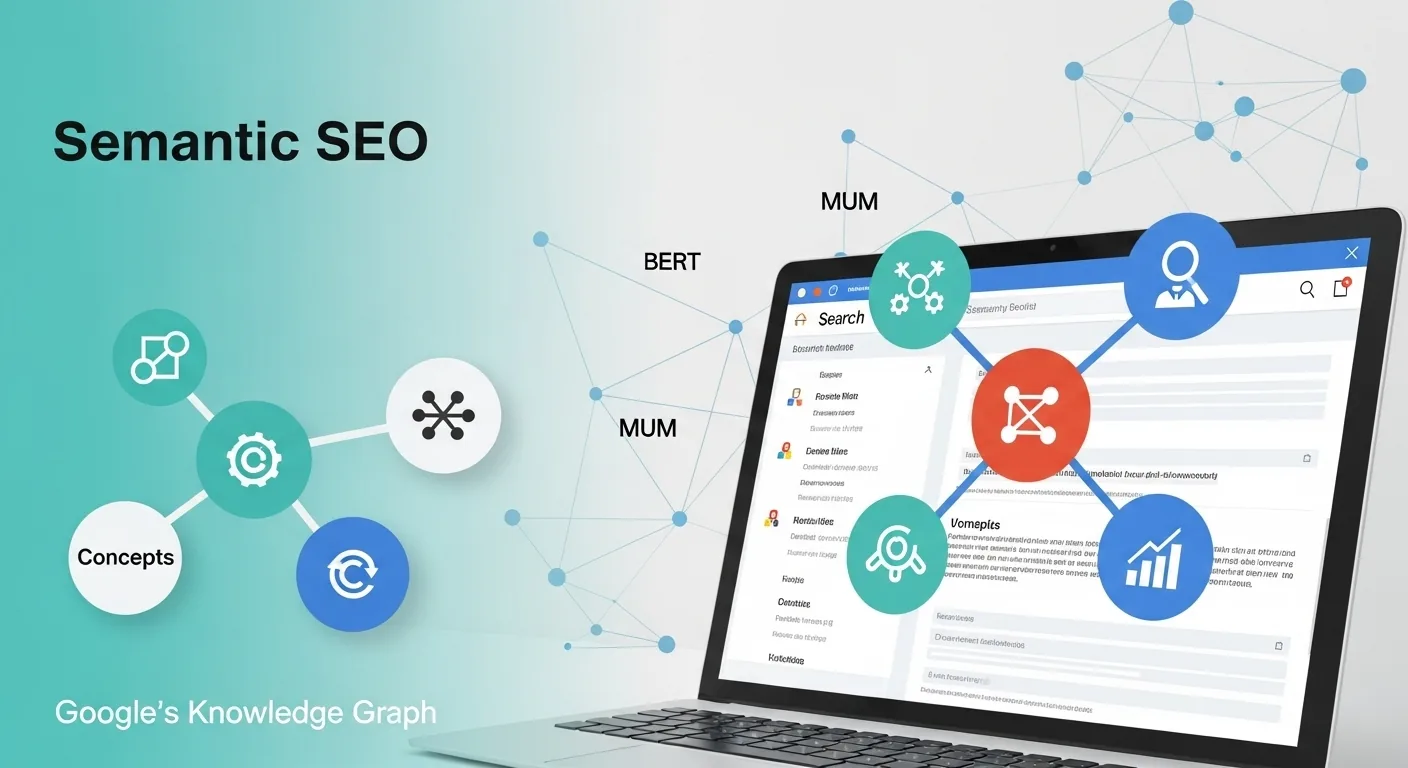
Semantic SEO optimises content to match the true meaning and context behind a user’s search query rather than relying solely on exact keyword matches. It focuses on concepts, entities, and relationships between words, enabling search engines to understand content more accurately and deliver highly relevant results.
Google’s shift started with the Knowledge Graph, BERT and MUM, and as of 2026 its ranking systems and AI features run on the Gemini family of models. Search algorithms have moved from keyword-based rankings to semantic understanding, interpreting user intent and context, and the pages that cover a topic’s entities and follow-up questions are the ones AI Overviews and AI Mode cite.
Key Concepts of Semantic SEO
- Semantic Search → Search engines analyse relationships between words, concepts, and entities to deliver more accurate results.
- Entities → Named items like people, places, organisations, or concepts recognised by search engines to build contextual relevance.
- Topic Clustering → Organising related keywords and content into thematic groups to demonstrate topical authority.
- Related Terms and Co-occurring Phrases → Semantically related terms that help search engines understand context.
- Search Intent → Recognising whether a query is informational, navigational, or transactional to deliver matching results.
Why Semantic SEO Matters
- Improves content relevance and search visibility.
- Helps pages rank for a broader set of related queries.
- Enhances user experience by delivering contextually accurate information.
- Increases chances of appearing in featured snippets, knowledge panels, and other rich results.
How Python Helps in NLP for SEO
Python has become one of the most popular digital marketing and SEO automation programming languages. Its simplicity, flexibility, and rich ecosystem of Natural Language Processing (NLP) libraries make it ideal for analysing and optimising content at scale.
Key Python Libraries for NLP and SEO
- NLTK (Natural Language Toolkit) → A powerful toolkit for text processing, tokenization, stemming, and part-of-speech tagging.
- spaCy → Advanced NLP library for entity recognition, dependency parsing, and linguistic annotations.
- scikit-learn → Used for machine learning tasks like keyword clustering and classification.
- Transformers and sentence-transformers (Hugging Face) → Pre-trained models for classification and sentiment, and small embedding models (all-MiniLM, bge) that turn keywords into vectors for clustering by meaning. Hosted embedding APIs from OpenAI, Gemini and others do the same job at scale.
- BeautifulSoup & Requests → For scraping web pages and extracting text data for SEO research.
How Python Can Enhance SEO with NLP
- Keyword Clustering → Grouping related keywords based on semantic similarity to plan topic clusters.
- Entity Extraction → Identifying key entities (people, places, brands) to align with semantic search signals.
- Sentiment Analysis → Understanding the tone of content to optimise for user engagement and brand perception.
- Content Optimisation → Detecting missing semantic concepts, improving keyword coverage, and generating meta descriptions automatically.
- Automating Repetitive SEO Tasks → From title tag checks to link audits, Python scripts can handle repetitive work efficiently.
Setting Up Python Environment for NLP
Before leveraging Python for Semantic SEO and NLP tasks, you need to set up a proper working environment. This ensures you have all the necessary tools and libraries ready for text processing and SEO automation.
Step 1: Install Python
- Download a current Python 3 release (3.10 or newer) from the official website.
- During installation, make sure to check the box “Add Python to PATH”.
- Verify the installation by running
python --versionin your terminal.

Step 2: Choose an IDE
Popular IDEs for Python:
- VSCode → Lightweight and beginner-friendly.
- PyCharm → Advanced features for large projects.
- Jupyter Notebook → Perfect for running code snippets and experiments.
Step 3: Install Essential Libraries
Run the following command to install commonly used NLP and SEO-related libraries:

Step 4: Download spaCy Language Model
For entity recognition and semantic text analysis, download the English model:

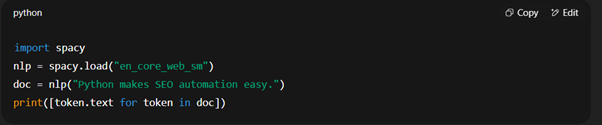
Step 5: Verify Installation
Test your setup by running:
Practical NLP Techniques for Semantic SEO
Python offers powerful NLP capabilities that can transform the way you approach semantic SEO. Below are practical techniques you can use to optimize your content for search engines that understand meaning and intent.
Keyword & Topic Clustering
Instead of targeting single keywords, modern SEO focuses on topic clusters—groups of semantically related keywords.
How to do it:
- Use Python with TF-IDF or word embeddings to measure similarity between keywords.
- Cluster them into groups that can be targeted with pillar and supporting content.
Example libraries:
- scikit-learn for TF-IDF and KMeans clustering.
- sentence-transformers for embeddings.
Named Entity Recognition (NER)
Search engines rely on entities to understand meaning and context.
How to do it:
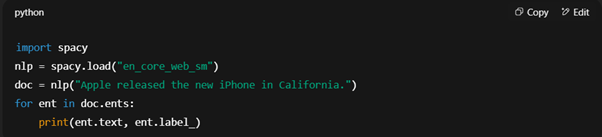
- Use spaCy to extract entities like brands, locations, and people from your content or competitors’ pages.
- Incorporate these entities naturally into your content for better semantic alignment.
Example:
Content Gap Analysis
Understanding what your competitors cover (that you don’t) helps you fill semantic gaps.
How to do it:
- Use cosine similarity to compare your content with top-ranking pages.
- Identify missing entities or topics to make your article more comprehensive.
Example:
Use sklearn‘s TfidfVectorizer to vectorize text and calculate similarity scores.
Sentiment & Intent Analysis
Search engines want to serve content that matches user intent and tone.
How to do it:
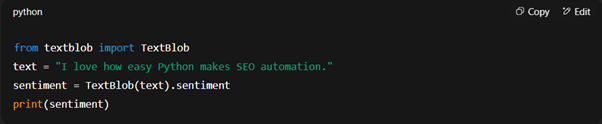
- Perform sentiment analysis with a transformers pipeline (TextBlob is enough for a quick English check) to gauge emotional tone.
- Classify intent (informational, navigational, commercial, transactional) with an LLM prompt or a trained classifier to optimise page copy.
Example:
Automated Schema & Knowledge Graph
Structured data helps search engines understand content relationships.
How to do it:
- Extract entities from your content.
- Use Python to auto-generate JSON-LD schema markup.
- Build a simple knowledge graph linking related pages and entities internally.
Python Code Examples
Below are practical Python code examples for each NLP technique used in Semantic SEO. These snippets will help you get started quickly and automate parts of your SEO strategy.
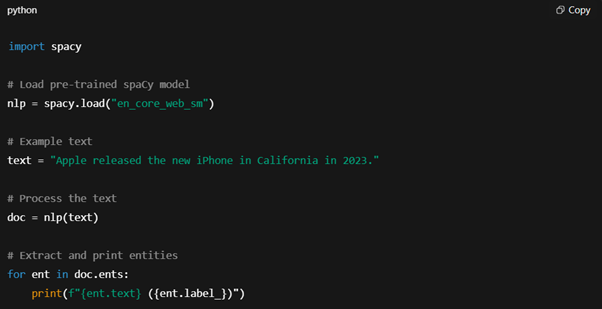
Extracting Entities with spaCy
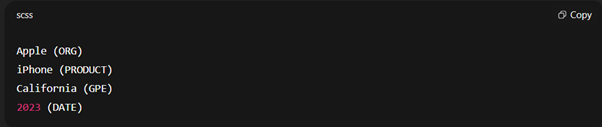
Named Entity Recognition (NER) identifies people, places, organizations, and more within your content. Here’s how to use spaCy to extract entities:
Output
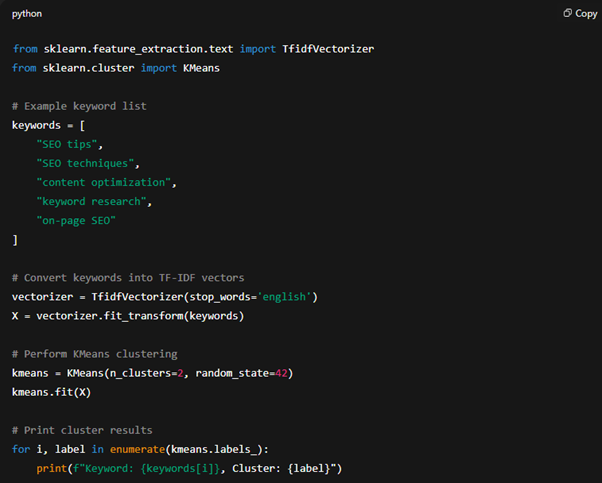
Clustering Keywords with scikit-learn (TF-IDF)
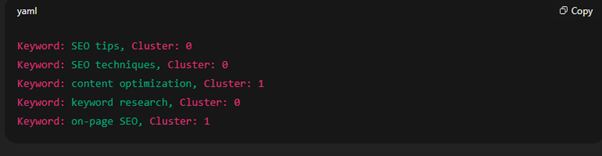
You can group related keywords based on their semantic similarity using TF-IDF. This is a simple example using scikit-learn:
Output
Sentiment Analysis with TextBlob
Use TextBlob for a quick sentiment check of English content. It is rule-based, so for decisions that matter use the transformers pipeline shown in the copyable code section further down.
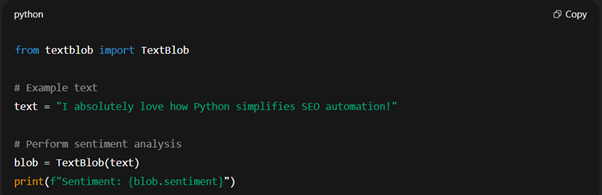
Output

(Polarity: Positive sentiment, Subjectivity: Opinion-based content)
Content Gap Analysis with Cosine Similarity
Use cosine similarity to compare your content with top-ranking competitors and identify content gaps.
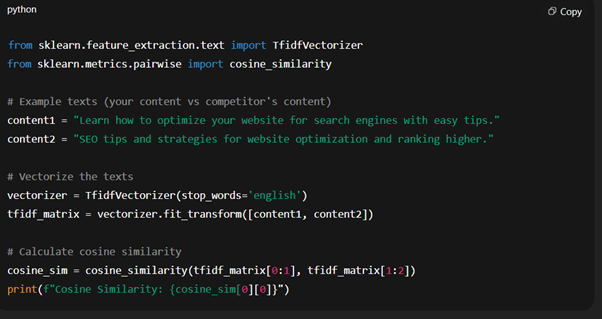
Output

Generating Schema Markup with JSON-LD
Automatically generate JSON-LD schema markup for entities like articles, products, or reviews. Here’s an example for FAQ schema (valid markup, though Google now shows FAQ rich results mainly for authoritative government and health sites):
import json
# FAQ schema example
faq_schema = {
    "@context": "https://schema.org",
    "@type": "FAQPage",
    "mainEntity": [
        {
            "@type": "Question",
            "name": "What is Semantic SEO?",
            "acceptedAnswer": {
                "@type": "Answer",
                "text": "Semantic SEO focuses on optimizing content based on meaning, context, and user intent rather than just keywords."
            }
        },
        {
            "@type": "Question",
            "name": "Why is Python used for SEO?",
            "acceptedAnswer": {
                "@type": "Answer",
                "text": "Python automates SEO tasks, making it easier to analyze content, optimize keywords, and generate structured data."
            }
        }
    ]
}
# Convert to JSON-LD
json_ld_schema = json.dumps(faq_schema, indent=4)
print(json_ld_schema)
Output
{
    "@context": "https://schema.org",
    "@type": "FAQPage",
    "mainEntity": [
        {
            "@type": "Question",
            "name": "What is Semantic SEO?",
            "acceptedAnswer": {
                "@type": "Answer",
                "text": "Semantic SEO focuses on optimizing content based on meaning, context, and user intent rather than just keywords."
            }
        },
        {
            "@type": "Question",
            "name": "Why is Python used for SEO?",
            "acceptedAnswer": {
                "@type": "Answer",
                "text": "Python automates SEO tasks, making it easier to analyze content, optimize keywords, and generate structured data."
            }
        }
    ]
}
Best Practices for Semantic SEO with Python
To truly leverage Python for Semantic SEO, following some best practices that align with both NLP techniques and search engine guidelines is essential. Here are key recommendations for getting the most out of Python in SEO automation.
Focus on User Intent, Not Keyword Stuffing
Search engines prioritise understanding user intent—the reason behind a search query—rather than simply matching keywords. Therefore, avoid keyword stuffing and create content that effectively answers user questions.
- Python Tip: Use sentiment analysis and intent classification to match your content’s tone and structure with the user’s likely intent (informational, navigational, transactional).
Regularly Update NLP Models
SEO is a constantly evolving field, and so are the algorithms used in NLP models. Keeping your Python models updated is crucial to maintain their relevance and accuracy.
- Python Tip: Keep spaCy and its language models up to date, refresh embedding models every year or so, and re-run your clustering when Google changes how it groups results.
Automate Internal Linking with Extracted Entities
Internal linking is essential for both user navigation and SEO. By automating the process of internal linking based on extracted entities and semantic concepts, you can improve site structure and search visibility.
- Python Tip: Use spaCy to extract entities from your content and automatically generate internal links to relevant pages or blog posts within your site. This enhances topical relevance and site navigation.
Avoid Overuse of Automation
While automation can save time, over-automation can lead to unnatural content and search engine penalty risks. It’s important to ensure that Python’s output aligns with human-readable content and adheres to SEO best practices.
- Python Tip: Ensure that content generated via Python (e.g., meta descriptions, keyword-rich headings) is manually reviewed for tone, relevance, and clarity.
Ensure Compliance with Search Engine Guidelines
When scraping competitor content or automating keyword research, always ensure that your methods comply with search engine guidelines. This includes following robots.txt rules, avoiding duplicate content, and respecting fair use.
- Python Tip: Use Python scripts to check for duplicate content or perform ethical scraping, ensuring that your practices align with Google’s terms and conditions.
Setup Commands at a Glance
The setup steps above are shown as screenshots. Here are the same commands as text you can copy into your terminal or command prompt. If you would rather not install anything, open a free Google Colab notebook and run the same commands with a ! in front of each pip line.
Check that Python is installed:
python --version
Install the core libraries:
pip install spacy nltk scikit-learn textblob requests beautifulsoup4 sentence-transformers pandas
Download the small English spaCy model:
python -m spacy download en_core_web_sm
Verify the setup:
python -c "import spacy; nlp = spacy.load('en_core_web_sm'); print([(e.text, e.label_) for e in nlp('Google opened an office in Lahore').ents])"
If the last command prints a list of entities, your environment is ready. On some systems you may need python3 and pip3 instead. Using a virtual environment (python -m venv venv) keeps these libraries separate from other projects.
The Code Examples as Copyable Text
The examples above are screenshots. Here is the same code as text, plus an embeddings version of the clustering step, which groups keywords by meaning rather than by shared words.
Entity extraction with spaCy
import spacy

nlp = spacy.load("en_core_web_sm")
text = "Daraz and Foodpanda compete for online shoppers in Lahore and Karachi."
doc = nlp(text)

for ent in doc.ents:
    print(ent.text, ent.label_)
Keyword clustering with TF-IDF and KMeans
from sklearn.feature_extraction.text import TfidfVectorizer
from sklearn.cluster import KMeans

keywords = [
    "seo services lahore", "seo company in lahore", "best seo agency lahore",
    "facebook ads cost pakistan", "facebook advertising price", "meta ads budget pakistan",
    "shopify store setup pakistan", "how to start online store pakistan",
]

X = TfidfVectorizer().fit_transform(keywords)
labels = KMeans(n_clusters=3, n_init=10, random_state=0).fit_predict(X)

for label, kw in sorted(zip(labels, keywords)):
    print(label, kw)
The same clustering with embeddings (recommended)
TF-IDF only matches shared words, so "cheap flights" and "low-cost airfare" land in different groups. Embeddings fix that. The model below is small, free and runs on a normal laptop.
from sentence_transformers import SentenceTransformer
from sklearn.cluster import KMeans

model = SentenceTransformer("all-MiniLM-L6-v2")
vectors = model.encode(keywords, normalize_embeddings=True)
labels = KMeans(n_clusters=3, n_init=10, random_state=0).fit_predict(vectors)

for label, kw in sorted(zip(labels, keywords)):
    print(label, kw)
For larger lists, a hosted embedding API (OpenAI, Gemini, Voyage and others offer one) gives better quality for a few cents per thousand keywords; the code is the same once you have the vectors.
Content gap check with cosine similarity
from sklearn.feature_extraction.text import TfidfVectorizer
from sklearn.metrics.pairwise import cosine_similarity

my_page = open("my_page.txt", encoding="utf-8").read()
competitor = open("competitor_page.txt", encoding="utf-8").read()

vec = TfidfVectorizer(stop_words="english")
X = vec.fit_transform([my_page, competitor])
print("Similarity:", round(cosine_similarity(X[0], X[1])[0][0], 3))

# Terms that matter on the competitor page but are missing from yours
terms = vec.get_feature_names_out()
mine, theirs = X[0].toarray()[0], X[1].toarray()[0]
gaps = [terms[i] for i in theirs.argsort()[::-1][:40] if mine[i] == 0]
print("Missing terms:", gaps[:20])
Sentiment: TextBlob or a transformers pipeline
TextBlob is fine for a quick English polarity check, but it is a rule-based scorer. For anything you will act on, a transformers pipeline is more accurate and handles longer, mixed-tone text:
from transformers import pipeline

classifier = pipeline("sentiment-analysis")
print(classifier("The delivery was late but the support team sorted it out quickly."))
Using an LLM for Entity and Intent Extraction
Since 2024 most SEO teams have stopped hand-building intent rules in spaCy. A large language model labels intent, extracts entities and suggests the sub-questions a page should answer, all from one prompt, and it understands Roman Urdu and mixed-language queries that English-only models miss. The example below uses the OpenAI-style chat API that many providers (OpenAI, Gemini, Groq, local servers such as Ollama) accept; swap the base URL and model name for whichever you use.
import json
from openai import OpenAI

client = OpenAI()  # reads OPENAI_API_KEY from the environment

keywords = ["seo services lahore price", "what is semantic seo", "daraz seller center login"]

prompt = (
    "For each keyword return JSON with fields: keyword, intent "
    "(informational, navigational, commercial, transactional), entities (list). "
    "Return a JSON list only.\n" + "\n".join(keywords)
)

response = client.chat.completions.create(
    model="gpt-4o-mini",
    messages=[{"role": "user", "content": prompt}],
    response_format={"type": "json_object"},
)

rows = json.loads(response.choices[0].message.content)
print(json.dumps(rows, indent=2))
Three practical notes:
- Cost. Small models label thousands of keywords for well under a dollar (a few hundred rupees), but batch 50 to 100 keywords per request rather than one at a time.
- Consistency. Give the model the exact label set and a few examples, and keep the temperature low, or the same keyword can get different labels on different runs.
- Review. Spot-check 5 to 10 percent of the output by hand, especially brand names and local terms. The model's labels are a draft of your keyword map, not the final version.
Why this matters for AI Overviews and AI Mode
Google's AI Overviews and AI Mode answer a query by pulling passages from pages that cover the entities and follow-up questions behind it, then cite those pages. A page built from an entity list and an intent map, with each sub-question answered in a clear paragraph, is far more likely to be cited than a page that repeats one keyword. The same scripts that find your content gaps therefore also tell you what to add to earn those citations.
Conclusion
To maximise Python’s effectiveness in Semantic SEO, focus on user intent rather than keyword stuffing and keep your NLP models and embeddings current. Use Python alongside your usual SEO tools for keyword and ranking data, and automate internal linking using extracted entities to strengthen site structure. While automation is valuable, ensure that content remains natural and follows Google’s guidelines. With these practices, Python can streamline content optimisation and improve both your rankings and your chances of being cited in AI Overviews and AI Mode.
Frequently asked questions
Do I need to be a programmer to use Python for SEO?
No. Basic Python is enough for most SEO scripts: installing libraries, reading a CSV of keywords, running a function and saving the result. Jupyter Notebook or Google Colab let you run code in small steps and see output immediately, and Colab needs no installation at all. Start by copying a working example, changing the input data to your own, and learning each line as you go.
What is the best Python library for semantic SEO?
It depends on the task. spaCy is the usual choice for entity extraction and text processing. sentence-transformers produces embeddings that group keywords by meaning better than word counts do. scikit-learn handles TF-IDF, clustering and similarity scores. Requests with BeautifulSoup collects page text. For intent labels and entity lists at scale, an LLM API is now the simplest option. Most semantic SEO projects combine two or three of these.
Does Google still use LSI keywords?
No. Google has said it does not use latent semantic indexing, an older information-retrieval method, and never did. What matters is covering a topic fully with related terms, entities and answers to follow-up questions, which is what Google's current language models (the Gemini family, after BERT and MUM) are built to understand. Use Python to find related concepts competitors cover, not to chase a list of so-called LSI keywords.
Which Python version should I use for these scripts?
Any supported Python 3 release from 3.10 upwards works for spaCy, scikit-learn and sentence-transformers as of October 2026. If you install the newest release the day it ships, some libraries may not have wheels for it yet, so a version one step behind the latest is the safest choice. Create a virtual environment per project so library upgrades do not break older scripts.